


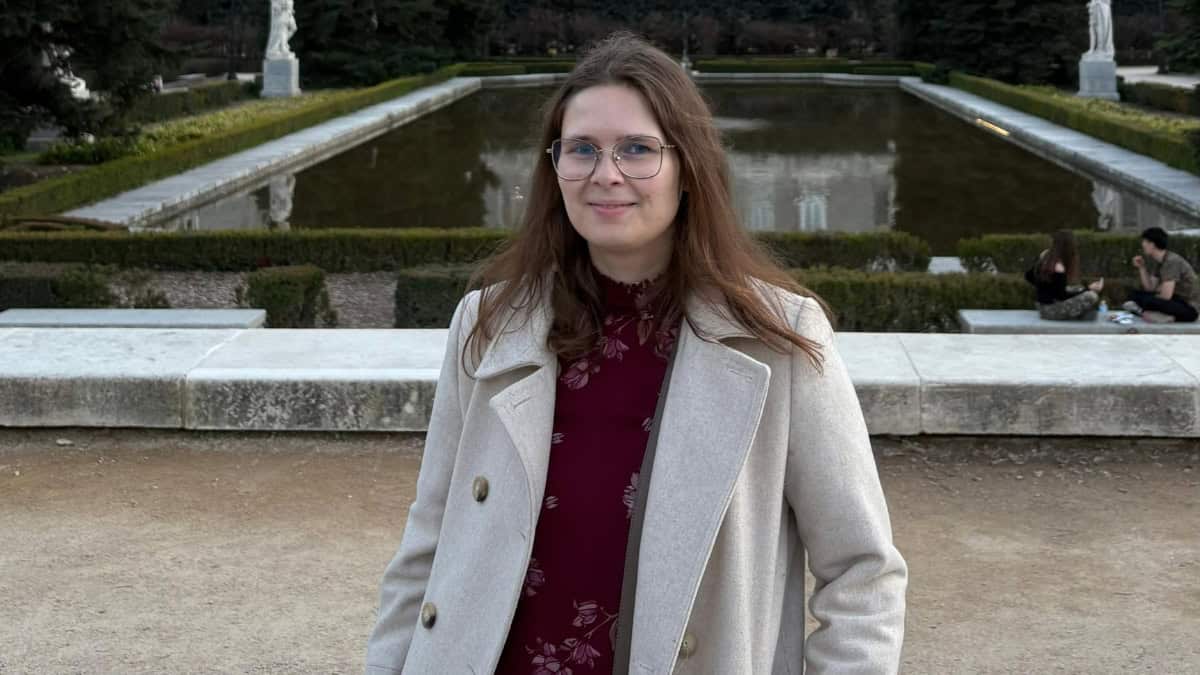
Rita Roque, a researcher at the Faculty of Sciences and Technology of the University of Coimbra, has been awarded the Best Paper by a Young Researcher in Atomic and Molecular Chemistry/Physics, for work that relied on the Deucalion supercomputer.
The award, granted by the Specialised Group on Atomic and Molecular Physics (GEFAM), a subgroup of the Royal Spanish Society of Physics and Chemistry, recognises the paper “Cold-Captured Dynamic Hydration Networks in Oxime-Based Photoswitches: A Theoretical Challenge Uncovered by Rotational Spectroscopy”, published in Angewandte Chemie International Edition. The paper was also highlighted as a Hot Paper by the journal’s editors and featured on the cover.
The research focused on the study of a prototype molecular switch, that is, molecules capable of alternating between two distinct three-dimensional configurations. Based on rotational spectroscopy measurements and advanced computational quantum chemistry calculations, the team identified a major theoretical challenge: many of the methods commonly used to model molecular systems proved unable to correctly predict the preferred structure of this switch.
For the theoretical side of the work, access to advanced computing resources was essential. Rita Roque notes that the quantum chemistry calculations required for the project were run on Deucalion, making it possible to complete the work within a useful timeframe. “For this work, it was necessary to prepare and interpret numerous quantum chemistry calculations run on Deucalion, which would have been impossible to complete in a timely manner without access to a supercomputer,” the researcher from the Department of Physics of the University of Coimbra explains.
The researcher also highlights the importance of access to the infrastructure in the development of the project. “The possibility of accessing Deucalion through advanced computing projects, the high processing capacity of its x86 partition, and the promptness of the support team made it possible to carry out the entire theoretical part of the project,” she adds.
The work was carried out within the framework of the MiCRoARTiS – Microwave Fingerprinting Artificial Molecular Motors in Virtual Isolation project, coordinated by Sérgio Domingos and funded by the European Research Council. Following this distinction, Rita Roque was invited to present the paper at the 17th Conference of Young Researchers in Atomic and Molecular Physics (J2IFAM 2026), held in Madrid in February.